
Introducing 4 Scenarios for the Future of Coaching
The future of coaching will be shaped by many forces, but two stand out for their transformative potential and high uncertainty: the pace of technological innovation and the degree of global collaboration. Together, these forces offer powerful insight into what the next decade may hold.
This section explores four plausible scenarios for coaching in the year 2036. Rather than forecasts or predictions, these scenarios are strategic tools, grounded in a structured foresight approach[i], to help you examine possibilities, challenge assumptions, and build adaptive capacity. The goal is not to be right about a specific future, but to be ready for the possibilities likely to emerge.
How Variables Shape Planning Scenarios
In Section 2, five drivers of change were identified. Among them, technological acceleration and collaborative ecosystems were identified as the most volatile and influential, ideal for a scenario planning matrix. These drivers define the two axes of a 2×2 scenario framework[ii] introduced below and explored more fully in this section.

- What If There Is Widespread Adoption? Digital tools like AI, immersive virtual environments, biometric feedback tools, and real-time virtual coaching assistants become core to coaching delivery. Coaching evolves into a hybrid experience combining human insight with predictive algorithms and personalized data streams.
- What If There Is Limited Adoption? Regulatory changes, reduced ethical oversight, infrastructure gaps, or cultural resistance slow technological integration. Coaching preserves a human-centered and relational-driven approach, with minimal use of advanced technologies.
- What If There Is Global Cooperation? Nations, communities, and sectors align to address shared challenges like climate mitigation and adaptation, social cohesion, and systemic inequity. Coaching becomes a tool for enhancing cross-border dialogue, capacity building, and collective transformation.
- What If There Is Fragmentation? Regions turn inward, with more focus on national or regional interests. Coaching becomes more fragmented, shaped by uneven standards, cultural interpretations, and access disparities.
4 Plausible Futures for Coaching
These two drivers intersect to generate four distinct scenarios. Each offers a provocative glimpse into how coaching could evolve by 2036. These are not predictions or prescriptions. They are thought experiments designed for you to anticipate change and adapt strategically.
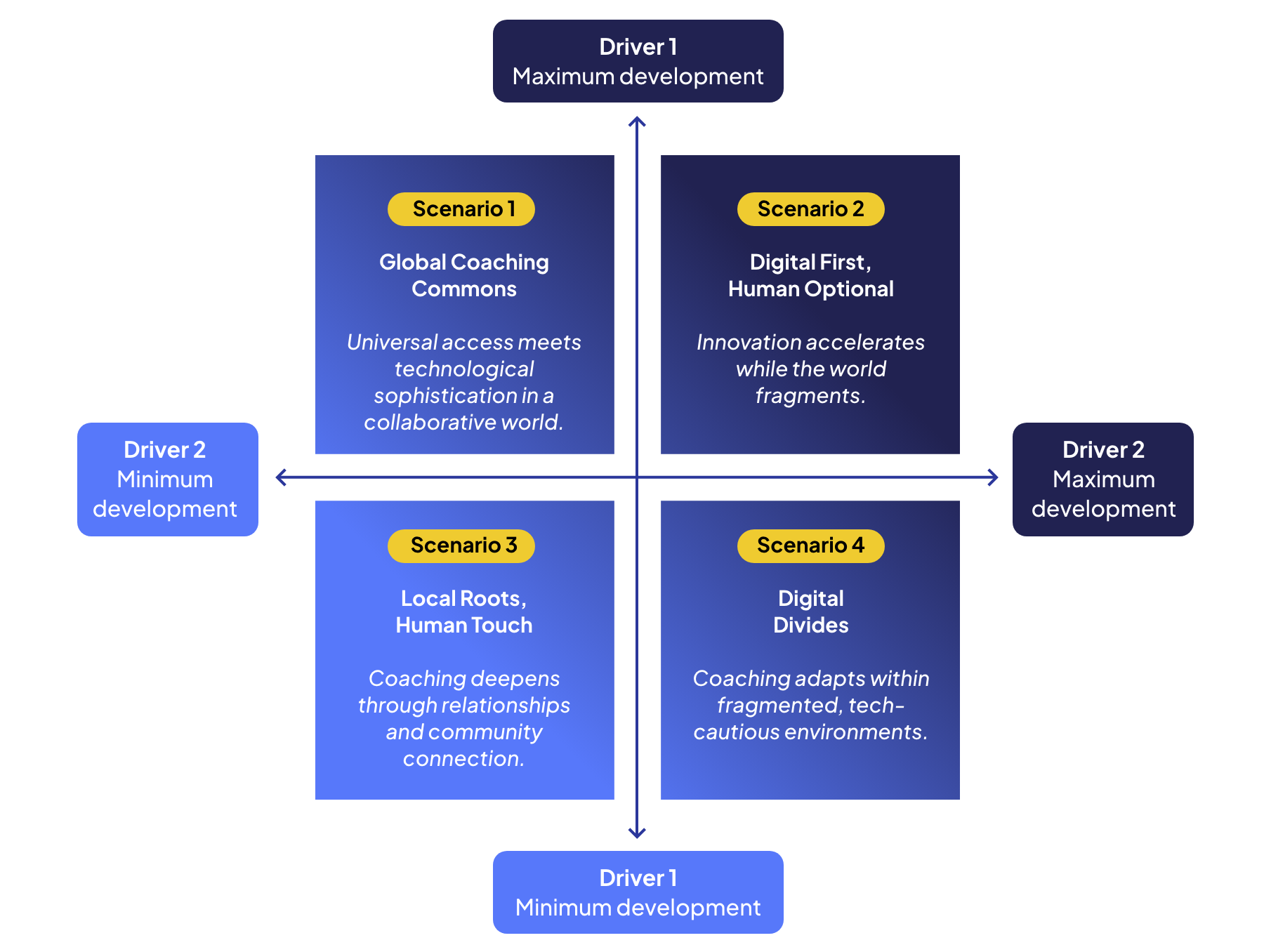
Universal access meets technological sophistication in a collaborative world.
In this imagined future, technology becomes deeply integrated into daily life and coaching practice. AI assistants, immersive platforms, and real-time feedback tools enhance coach and client experiences. Global collaboration accelerates as organizations, governments, and communities unite around shared challenges. Coaching transcends borders, advancing inclusive leadership, systems transformation, and collective well-being. Coaches become essential partners in global development and cross-sector change.
Innovation accelerates while the world fragments.
Here, coaching becomes increasingly tech-enabled through advanced personalization, access, and scaling tools. However, weak global collaboration creates imbalanced access and ethical dilemmas. Political tensions, regional instability, and resource disparities lead to uneven adoption of coaching, which is well-resourced in some areas while restricted or misunderstood in others. Coaches navigate a landscape where technological innovation increasingly influences social cohesion.
Coaching deepens through relationships and community connection.
In this future, technology adoption remains cautious and limited. People gravitate toward human connection, presence, and purpose, embracing slower, more contemplative approaches to well-being. At the same time, strong global collaboration produces shared commitments to health, equity, and sustainability. Coaching becomes central to local leadership, relational healing, and social cohesion. Coaches anchor their work in community-based models and human-centered practices that prioritize building trust over technology.
Coaching adapts within fragmented, tech-cautious environments.
This future emerges from limited technological adoption and increasing global fragmentation. Coaching maintains its traditional, person-centered approach, yet access and impact vary widely. Some areas view coaching as vital for managing conflict, burnout, and societal pressure, while others see it as not affordable or seek alternative support systems. Coaches operate within localized contexts while navigating social divisions, resource constraints, and rising demand for trauma-informed approaches.